5x revenue in 3 months for a customised jewellery brand
Niche — Customised Jewellery
Target Market — Philippines
ROAS achieved — 5x blended (Reported)
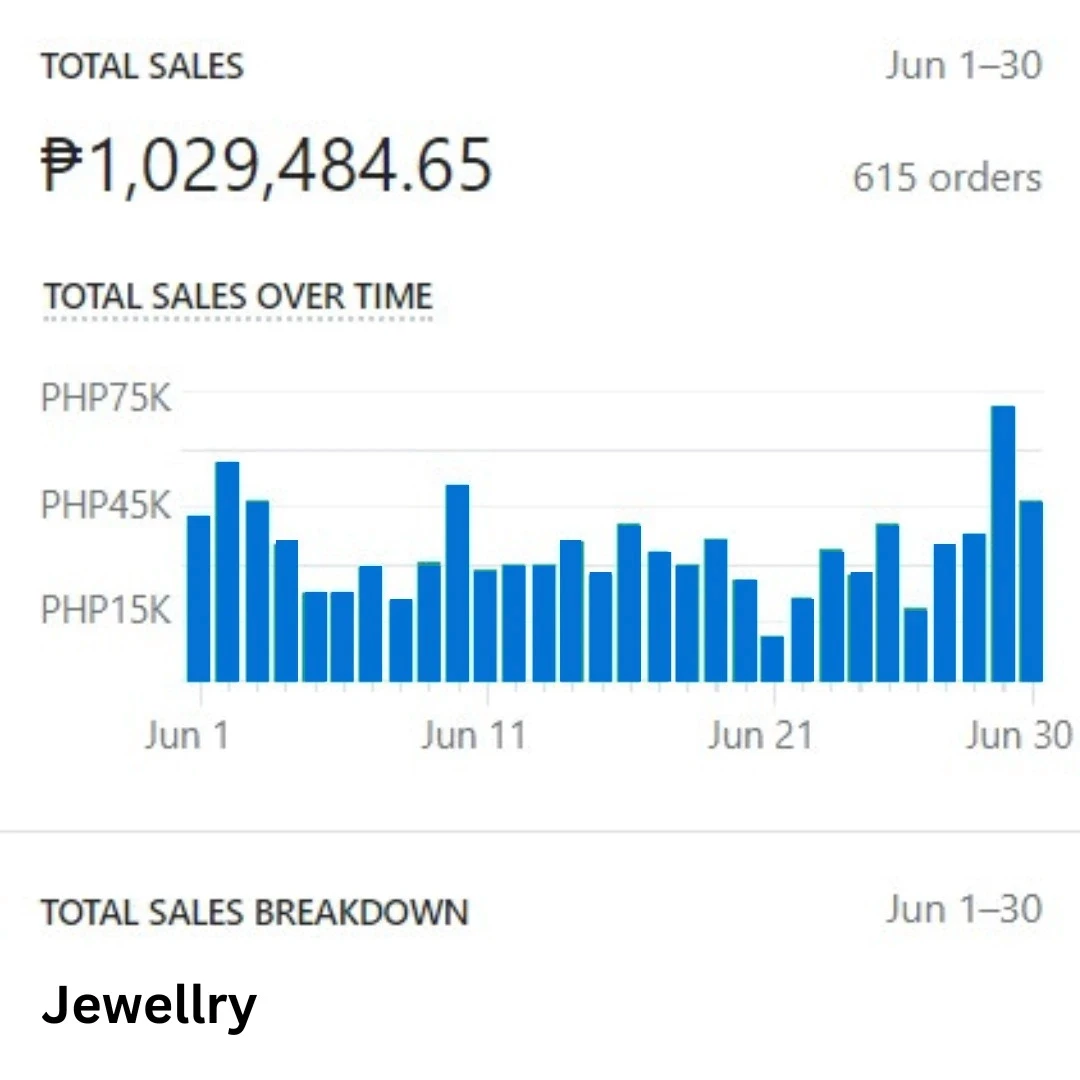
Revenue — ₱200k → ₱1M/mo (~$3.7k → $18k) · Ad spend — ₱100k → ₱200k/mo ($1.8k → ~$3.7k) · Blended ROAS — 2x → 5x · AOV — ₱7k ($128) · Timeline — 3 months · Channels — Meta + TikTok
When Printave came to us, they were already in motion — running Meta ads at a 2x ROAS, spending around ₱100k a month to bring in roughly ₱200k in revenue. The model was built around customisation: ads pulled people into DMs, a well-equipped in-house sales team closed the order over chat, and the sale was placed on the website. It worked. Our job wasn't to rebuild it — it was to scale it without breaking what was already converting.
Month one: fixing the Meta account
The account hadn't really been optimised — there was no clean separation between content meant to introduce the brand and content meant to close a sale. So we split it into top-funnel and bottom-funnel, and brought in direct conversion campaigns it had never properly run. Messaging campaigns — the brand's natural strength — climbed to 3.5–4.5x. Direct conversion started slower at around 2.5x, simply because the account had never been built to convert that way. By the end of the month, Meta had moved from 2x to 3–3.5x overall.
Month two: a new channel that paid off somewhere else
Printave's organic TikTok was already pulling, so we turned on TikTok ads. It was a new channel for the brand, with no conversion history to optimise against — so on its own, the campaigns barely cleared 1–1.2x. On paper, that looks like a miss. It wasn't. Within 15–20 days of TikTok going live, Meta remarketing jumped from 4.5–5x to 7–8x — the new audiences TikTok was warming up were coming back and converting on Meta. Judged in isolation, TikTok looked weak. Judged across the funnel, it was doing the heavy lifting. Blended ROAS for the month sat around 5x.
Month three: two channels, two jobs
With TikTok firing, both channels had their own lane. TikTok ran the direct conversion play with content built specifically for it. Meta leaned into what it did best — messaging campaigns — and we pulled budget out of Meta's direct conversion where messaging was simply doing it better. Over the three months we roughly doubled spend, from ~₱100k to ₱200k a month — and revenue grew far faster than that. The brand closed month three at around ₱1M ($18k) — about 140 orders at a ~₱7k AOV — at a 5x blended ROAS. Five times the revenue it started with, on twice the spend.
And it held. The account ran at around 4.8x for a couple more months before Printave brought everything in-house — which, for a system this stable, we took as the compliment it was.
Main observations
1. Messaging carried the account — like nothing before or since.
The brand's DM-led, sales-team-closed model meant messaging campaigns did heavy lifting we haven't seen replicated on any account before or after — running at 3.5–4.5x while direct conversion sat around 2.5x.
2. Emotion out-converted anything polished.
The creative that worked wasn't product photography — it was story. One of the strongest performers was built around a customer commissioning a pendant that carried a photo of her late grandmother. Memory, not merchandising, was the hook.
3. Social proof, shown not told.
Review-screenshot ads and storytelling creative cut from the same emotional cloth were the other consistent winners. Real words from real customers beat anything we could write about the brand.
4. The first lever was funnel separation.
Before scaling anything, we split top-funnel content from bottom-funnel content. Much of the early lift came from this alone.
5. A "weak" channel can be your strongest one.
TikTok barely cleared 1–1.2x on its own, then pushed Meta remarketing from 4.5–5x to 7–8x within 15–20 days. The value never showed up where the spend went — it showed up downstream.
6. The backend held up.
75–80% of orders came in prepaid, with negligible RTO on the COD orders — so the revenue was clean, not inflated by returns.
The takeaway
The thread through all three months: you can't judge a channel by its own campaign-level ROAS. The moment we stopped reading TikTok in isolation and started reading the funnel as one system, the real numbers showed up — on Meta, in remarketing, and in the blended return.
Hope this is helpful!
Want this kind of growth for your brand? Let's chat →
Niche — Customised Jewellery
Target Market — Philippines
ROAS achieved — 5x blended (Reported)
Revenue — ₱200k → ₱1M/mo (~$3.7k → $18k) · Ad spend — ₱100k → ₱200k/mo ($1.8k → ~$3.7k) · Blended ROAS — 2x → 5x · AOV — ₱7k ($128) · Timeline — 3 months · Channels — Meta + TikTok
When Printave came to us, they were already in motion — running Meta ads at a 2x ROAS, spending around ₱100k a month to bring in roughly ₱200k in revenue. The model was built around customisation: ads pulled people into DMs, a well-equipped in-house sales team closed the order over chat, and the sale was placed on the website. It worked. Our job wasn't to rebuild it — it was to scale it without breaking what was already converting.
Month one: fixing the Meta account
The account hadn't really been optimised — there was no clean separation between content meant to introduce the brand and content meant to close a sale. So we split it into top-funnel and bottom-funnel, and brought in direct conversion campaigns it had never properly run. Messaging campaigns — the brand's natural strength — climbed to 3.5–4.5x. Direct conversion started slower at around 2.5x, simply because the account had never been built to convert that way. By the end of the month, Meta had moved from 2x to 3–3.5x overall.
Month two: a new channel that paid off somewhere else
Printave's organic TikTok was already pulling, so we turned on TikTok ads. It was a new channel for the brand, with no conversion history to optimise against — so on its own, the campaigns barely cleared 1–1.2x. On paper, that looks like a miss. It wasn't. Within 15–20 days of TikTok going live, Meta remarketing jumped from 4.5–5x to 7–8x — the new audiences TikTok was warming up were coming back and converting on Meta. Judged in isolation, TikTok looked weak. Judged across the funnel, it was doing the heavy lifting. Blended ROAS for the month sat around 5x.
Month three: two channels, two jobs
With TikTok firing, both channels had their own lane. TikTok ran the direct conversion play with content built specifically for it. Meta leaned into what it did best — messaging campaigns — and we pulled budget out of Meta's direct conversion where messaging was simply doing it better. Over the three months we roughly doubled spend, from ~₱100k to ₱200k a month — and revenue grew far faster than that. The brand closed month three at around ₱1M ($18k) — about 140 orders at a ~₱7k AOV — at a 5x blended ROAS. Five times the revenue it started with, on twice the spend.
And it held. The account ran at around 4.8x for a couple more months before Printave brought everything in-house — which, for a system this stable, we took as the compliment it was.
Main observations
1. Messaging carried the account — like nothing before or since.
The brand's DM-led, sales-team-closed model meant messaging campaigns did heavy lifting we haven't seen replicated on any account before or after — running at 3.5–4.5x while direct conversion sat around 2.5x.
2. Emotion out-converted anything polished.
The creative that worked wasn't product photography — it was story. One of the strongest performers was built around a customer commissioning a pendant that carried a photo of her late grandmother. Memory, not merchandising, was the hook.
3. Social proof, shown not told.
Review-screenshot ads and storytelling creative cut from the same emotional cloth were the other consistent winners. Real words from real customers beat anything we could write about the brand.
4. The first lever was funnel separation.
Before scaling anything, we split top-funnel content from bottom-funnel content. Much of the early lift came from this alone.
5. A "weak" channel can be your strongest one.
TikTok barely cleared 1–1.2x on its own, then pushed Meta remarketing from 4.5–5x to 7–8x within 15–20 days. The value never showed up where the spend went — it showed up downstream.
6. The backend held up.
75–80% of orders came in prepaid, with negligible RTO on the COD orders — so the revenue was clean, not inflated by returns.
The takeaway
The thread through all three months: you can't judge a channel by its own campaign-level ROAS. The moment we stopped reading TikTok in isolation and started reading the funnel as one system, the real numbers showed up — on Meta, in remarketing, and in the blended return.
Hope this is helpful!
Want this kind of growth for your brand? Let's chat →


